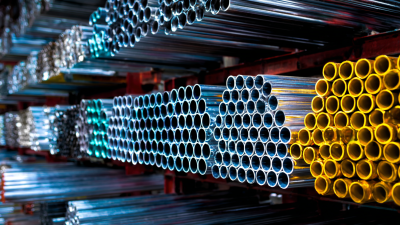
So, when you're picking a pipe material, you're really weighing a few things—weight, how long installation will take, durability, and what maintenance looks like down the road. Aluminum pipe tends to pop up a lot for frames, fluid systems, and equipment where you want something light and corrosion-resistant. And honestly, a single section is just easier to handle than steel of the same size—especially if crews are doing a bunch of cuts or working overhead. Bottom line: light makes a difference.
Sure, aluminum is great at conducting heat and electricity—no argument there. But that doesn't mean it's always the obvious pick. Honestly, the right choice really depends on what you're using it for. Its advantages only get you so far. Things like alloy, temper, wall thickness, diameter, and how it's manufactured all play a role in strength and performance. And corrosion resistance? It's not a given. Get it around certain chemicals, salt, different metals touching it, or just constant moisture, and the whole picture can change. In those situations, you might need protective coatings or maybe a completely different material.
Honestly, picking the right pipe isn’t just about grabbing whatever’s on sale. You’ve got to start with what the system actually needs to do. Look at the supplier’s specs—material data, dimensional tolerances, pressure ratings—for the exact product, and double-check that they fit your intended use. Think about how you’re going to join it, support it, cut it, and inspect it later. And don’t overlook thermal expansion and wear; those can bite you in ways that won’t show up on a drawing. In the end, the little details are what make or break it.
So, when does aluminum pipe actually make sense? That’s what this guide is really about—plus the trade-offs you should keep an eye on, and the specs worth double-checking before you place an order. To be clear, it’s not the magic answer for every job. If you’re dealing with serious loads, high temperatures, or pressure, getting a qualified engineer to review things isn’t just a nice-to-have; it’s a pretty important step. Bottom line? Pick what the evidence and your site conditions support, not some blanket rule that one material is always best.
Aluminum pipe is a hollow product used to move fluids, support structures, or protect cables. Its low weight can make handling easier, especially when workers carry long sections across a site. Corrosion resistance is useful in many environments, but it does not make every alloy suitable for every exposure. Not every grade fits.
Aluminum pipe is commonly classified by alloy, manufacturing method, and temper. Alloy numbers indicate different compositions and properties: some grades prioritize strength, while others are easier to form or weld. Pipe may be seamless or welded. Seamless pipe is formed without a welded seam; welded pipe is made from formed material joined along a seam. Temper describes how the metal was processed and can affect strength and flexibility. Exact naming systems vary by supplier, so check the product specification rather than relying on a label alone. This detail is easy to overlook.
Tips: Match the pipe’s alloy and temper to the fluid, pressure, temperature, and joining method. Compare the stated dimensions and wall thickness with your design. If the application is demanding, confirm the specification with a qualified materials professional before ordering.
Aluminum pipe often begins as a cast billet, whose alloy composition is checked before heating. The billet is warmed, commonly to roughly 400–500°C, then pushed through a shaped die. For hollow pipe, a mandrel forms the inside opening. Some extrusion methods use a porthole die, where separate metal streams meet under pressure. The method affects whether the product is seamless or contains a pressure-welded seam. It is not magic.
After extrusion, the hot tube is cooled, stretched or straightened, and cut to length. Some alloys need age-hardening heat treatment to reach their specified strength. Makers check wall thickness, diameter, and surface condition; seam-sensitive applications may need additional inspection. Heat and alloy variation can still shift dimensions. That part deserves attention, not guesswork.
The International Aluminium Institute reports that recycling aluminum uses about 5% of the energy required to make primary aluminum. That figure compares metal production routes, not the full pipe-manufacturing process. Recycled feedstock can reduce upstream energy demand, but sorting scrap and controlling alloy chemistry remain essential. A low-energy input means little if the finished pipe misses its dimensional or mechanical requirements.
Aluminum pipe is useful when a project needs low weight without giving up practical strength. It is much lighter than steel, so long sections are easier to handle and can reduce the load on frames or supports. Light, but capable. The exact strength depends on the alloy, temper, wall thickness, and manufacturing method, so check specifications rather than relying on the word “aluminum” alone.
A natural oxide layer helps aluminum resist corrosion in many ordinary environments. It also transfers heat well, which can suit some cooling, heating, or fluid-handling applications. Cutting and machining are generally straightforward with suitable tools. Still, aluminum is not a cure-all: it is less stiff than steel, and contact with other metals or harsh chemicals may need careful design. It is easy to overvalue low weight and overlook wear, pressure, or temperature requirements.
Tips: Match the pipe’s alloy and wall thickness to the actual load and operating conditions. Check compatibility at joints, especially where dissimilar metals meet. For a small prototype, inspect cut edges and connections after assembly; real conditions can expose issues a drawing misses.
| Property | Typical value or behavior | Why it matters for a project |
|---|---|---|
| Density | Approximately 2.70 g/cm³ for aluminum; exact values vary slightly by alloy. | Its low density can reduce pipe weight, making components easier to handle and helping lower the load on supporting structures. |
| Strength | Strength depends on alloy, temper, dimensions, and product standard. For example, 6061-T6 aluminum commonly has a minimum yield strength around 240 MPa in applicable product specifications. | Heat-treated alloys can provide useful structural strength. Select a grade and pipe specification based on the required loads and applicable design codes. |
| Elastic modulus | Approximately 69 GPa for common aluminum alloys. | Aluminum is less stiff than steel, so a pipe may need a larger diameter or thicker wall to meet deflection requirements. |
| Thermal conductivity | Common aluminum alloys are typically around 120–180 W/(m·K), with the value varying by alloy and temper. | Good heat conduction can be useful in heat-transfer equipment and thermal-management applications. |
| Corrosion behavior | Aluminum naturally forms a thin protective oxide layer. Performance depends on the environment, alloy, surface condition, and contact with other metals. | It can perform well in many atmospheric environments. Marine, chemical, or dissimilar-metal contact conditions may require specific alloy selection or protective measures. |
| Thermal expansion | Approximately 23 × 10⁻⁶ per °C for common aluminum alloys. | Allow for movement in long pipe runs exposed to temperature changes, using suitable supports, joints, or expansion provisions. |
| Melting range | Many wrought aluminum alloys melt over a range of roughly 580–660°C; the precise range depends on alloy composition. | Consider temperature limits carefully. Aluminum is not suitable for every high-temperature service, and strength can decrease as temperature rises. |
| Fabrication and joining | Aluminum pipe can be cut, formed, machined, and joined, but the appropriate process depends on the alloy, temper, wall thickness, and service requirements. | Its fabrication options can support lightweight assemblies; welding may affect the properties of heat-treated alloys near the weld. |
| Recyclability | Aluminum is recyclable, and recycling generally requires substantially less energy than producing primary aluminum from ore. | Recyclability can support material-recovery and resource-efficiency goals at the end of a product’s service life. |
Aluminum pipe performs well where low weight, corrosion resistance, and easy installation matter. In factory compressed-air lines, technicians can carry long sections overhead and fit them around beams with less lifting effort. The Aluminum Association’s Aluminum Design Manual lists aluminum’s density at about 2.7 g/cm³; carbon steel is about 7.85 g/cm³, according to the AISC Steel Construction Manual. That difference can reduce handling weight, though actual system weight depends on pipe dimensions and fittings. A practical fit.
It is also useful in HVAC and liquid-cooling systems, where aluminum’s thermal conductivity helps move heat. The Aluminum Association reports conductivity near 167 W/m·K for 6061 aluminum, though values vary by alloy and temper. Check fluid compatibility, operating pressure, temperature, and joint design before specifying a system. Aluminum can corrode in certain chemical environments, and contact with dissimilar metals may create galvanic corrosion if connections are not properly isolated. Not universal. A site survey matters: pipe exposed to harsh washdown chemicals may need another material, even when aluminum looks ideal on paper.
Aluminum’s low density makes it a strong choice when reducing pipe weight matters, such as in mobile equipment and weight-sensitive structures. The chart shows typical material densities; actual pipe performance also depends on alloy, wall thickness, design, and operating conditions.
Selecting aluminum pipe starts with the job, not the material’s light weight. Define the fluid, operating temperature, pressure, support spacing, and exposure to moisture or chemicals. Then specify alloy, temper, outside diameter, and wall thickness. These details affect strength, corrosion resistance, and joining methods. A pipe carrying warm water indoors has different demands from one exposed to salt spray. Check pressure ratings against the supplier’s calculations and the applicable engineering standard, rather than relying on a generic chart. Fit matters.
Also compare installation and lifecycle needs. Aluminum is about one-third the density of steel, which can ease handling and reduce structural loads, but thin walls may dent under impact. Check for galvanic corrosion where the pipe meets copper or steel; suitable isolation may be needed. The International Aluminium Institute reports that recycling aluminum can require about 5% of the energy used for primary production. Recycled content may support project goals, but confirm the required alloy and documented material properties. Details matter. One imperfect but useful step is to mock up a short section with the actual fittings: it can reveal clearance or joining problems before the full run is installed.
Why Choose Aluminum Pipe for Your Project?
What Limitations to Consider Before Choosing Aluminum Pipe
Aluminum pipe is light and naturally forms a protective oxide layer. Its density is about 2.70 g/cm³, roughly one-third that of steel. But lower weight does not mean equal stiffness. The Aluminum Association’s Aluminum Design Manual gives aluminum an elastic modulus near 69 GPa, compared with about 200 GPa for steel. Under the same load, a similar-sized aluminum pipe may deflect more. That matters. Long spans may need closer supports or thicker walls, adding cost and weight.
Pressure and temperature need careful checking. Capacity varies with alloy, temper, wall thickness, diameter, and connection type. Heat can reduce strength, while salty or chemically aggressive fluids may cause localized pitting. Contact with copper or steel can also encourage galvanic corrosion when moisture is present. These risks depend on the actual environment; a general material comparison cannot replace a pipe-system calculation.
Tips: Confirm the fluid, operating pressure, temperature, and alloy before specifying pipe. Check support spacing and deflection, not just weight. Where dissimilar metals meet, consider suitable isolation and inspect damp joints regularly. A quick weight comparison is not enough.
It weighs much less than steel, making long sections easier to lift and support. Light, but capable. Strength still depends on the alloy and wall thickness.
No. Aluminum’s elastic modulus is about 69 GPa, compared with roughly 200 GPa for steel. A similar-sized pipe may bend more under the same load.
Check the alloy, temper, diameter, wall thickness, and connection type. Pressure capacity varies. A quick weight comparison is not enough.
Heat can reduce its strength, so check the expected operating temperature and the pipe’s specifications. Don’t guess from appearance.
Its natural oxide layer helps in many ordinary environments. Salty fluids or harsh chemicals can still cause localized pitting.
Yes. Moisture between aluminum and metals such as copper or steel can encourage galvanic corrosion. Inspect damp joints and consider suitable isolation.
It is generally straightforward to work with suitable tools. For a prototype, inspect cut edges and connections after assembly. Small flaws can matter.
Check support spacing and deflection, not just total weight. Long spans may need closer supports or thicker walls. I would not assume a lighter pipe always saves effort.
Aluminum Pipe is a lightweight, corrosion-resistant tubing product available in different alloys, tempers, shapes, and dimensions to suit varied project needs. It is typically made by extrusion or other forming processes, then cut and finished to meet requirements for strength, fit, and surface quality. Its low weight, useful strength-to-weight ratio, thermal conductivity, and ease of fabrication make it a practical option for many systems and structures.
It performs well in applications such as fluid transfer, ventilation, equipment, and lightweight construction, especially where easy handling and resistance to weathering are valuable. Choosing the right pipe means considering the fluid or environment, pressure and temperature, required strength, dimensions, connection method, and applicable project specifications. Aluminum is not ideal for every situation: its strength and wear resistance vary by alloy, it may be vulnerable to certain corrosive conditions, and it can react with dissimilar metals. Careful evaluation helps ensure the material fits the project’s performance and service-life needs.