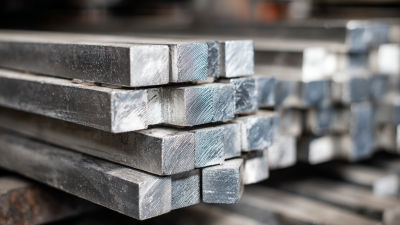
Picking the right aluminum square bar supplier in 2026 isn’t just about comparing online prices — there's a bit more to it. Things like alloy type, temper, how tight the dimensional tolerances are, the surface finish, and how reliable the delivery actually affects what you end up paying and how smoothly your project goes.
In this guide, we’ll walk through some of the top manufacturers and suppliers who serve folks in construction, machining, transport, and industrial fabrication. We look at production capacity, material traceability, certifications, stock levels, and customer support — all the stuff that really matters. Names like Hydro, Kaiser Aluminum, Ryerson, Metal Supermarkets, Online Metals, and Aalco pop up here, but whether they’re the right fit depends on what grade, size, and quantity you need, plus where they’ll be shipping to.
Honestly, little details count. For example, if you’re ordering a square bar of 25 millimeters, you might also need tight bends at the corners or precise straightness. Someone into machining might be after 6061-T6, while a structural engineer might need certain certifications and documentation. It’s always smart to check the mill test reports, heat numbers, packaging quality, and inspection records before you buy.
Of course, no supplier is perfect. How well they perform can vary based on where you are, how much you’re ordering, and current market conditions. Some are real manufacturing pros, while others excel in quick delivery and distribution. It’s best to double-check their current certifications, lead times, minimum order quantities, and return policies straight from the source.
This overview is meant to give you a good starting point for evaluating aluminum square bar suppliers — focusing on real, transparent info instead of just flashy marketing claims. Yeah, it takes a bit more effort, but it’s worth it — it helps you avoid costly surprises and makes the whole process a lot less stressful.
An aluminum square bar is a solid metal profile with four equal, flat sides and sharp or slightly rounded corners. Manufacturers produce it by extrusion, drawing, or cutting from larger aluminum stock. Its cross-section remains consistent along the full length. That consistency makes it useful for frames, supports, machine parts, brackets, and decorative structures.
Aluminum square bars are lightweight, corrosion-resistant, and easier to machine than many steel alternatives. Different alloys provide different balances of strength, weldability, and hardness. For example, a structural project may need a stronger heat-treated alloy, while a simple trim component may favor easier cutting.
In practical inspections, surface finish, straightness, corner condition, and dimensional tolerance matter greatly. A bar can look clean but still twist slightly. I have seen that problem create gaps during assembly. It is easy to overlook.
Tips: Confirm the alloy, temper, dimensions, and tolerance before ordering. Measure wall-free solid sections with calipers, not by appearance. Check for scratches, oxidation, and bending under bright light. Leave machining allowance when precise fitting is required. Also, ask for a material certificate when traceability matters. Small details matter.
Aluminum square bars serve in frames, machine parts, supports, and precision fixtures. Their four flat faces simplify cutting, drilling, welding, and assembly. Grade selection matters more than surface appearance.
6061 aluminum square bar offers balanced strength, corrosion resistance, and machinability. It suits brackets, equipment frames, and general fabrication. Its typical tensile strength ranges near 310 MPa, depending on temper and processing.
6063 provides smoother extrusion surfaces and better formability. It works well for architectural trim, light frames, and visible components. However, it usually sacrifices strength for appearance and easier shaping.
6082 is a stronger option for structural applications and heavily loaded supports. It performs reliably in many outdoor environments, though welding can reduce strength near the heat-affected zone.
7075 delivers high strength with lower corrosion resistance than common 6000-series grades. It fits aerospace-style fixtures, tooling, and weight-sensitive parts, but it costs more and welds poorly. Not every strong alloy is practical.
Experienced buyers should verify temper, dimensional tolerance, straightness, and actual mill test data. A 25 mm bar may look accurate but still require inspection along its full length. Check hardness, surface scratches, corner radius, and cutting allowances before production.
I once underestimated distortion after machining a long bar. That mistake changed the final fit.
Ask suppliers about batch consistency, packaging, and traceability. “Aircraft grade” alone proves little without documented specifications.
Choosing an aluminum square bar manufacturer requires more than comparing prices. USGS Mineral Commodity Summaries 2025 estimated global primary aluminum production at about 72 million metric tons in 2024. Large output does not guarantee accurate bars. Ask for alloy certificates, temper records, and lot-level traceability before approval.
Check whether the supplier follows ASTM B221 or equivalent requirements. Confirm width, corner radius, straightness, and tolerance ranges on the inspection report. A 25 mm bar may look correct, yet a 0.3 mm variation can disrupt a sliding assembly. Request recent test results for tensile strength, hardness, and chemical composition. Ask for evidence.
Manufacturing experience appears in process details. Reliable suppliers explain billet quality, extrusion temperature control, aging treatment, and surface protection. They should also show how rejected material is separated and recorded. The International Aluminium Institute reports that recycled aluminum requires roughly 5% of the energy used for primary production. Recycled content can support procurement goals, but its percentage needs verification. A sustainability claim without mass-balance records is weak.
Production capacity matters, but delivery promises deserve scrutiny. Compare stated monthly output with your required volume, packaging method, and previous lead-time records. Inspect sample bars under warehouse lighting and after cutting. Minor scratches may be acceptable for structural use, but not for visible assemblies. No evaluation is perfect. I would still reassess suppliers after the first three deliveries, because a polished certificate cannot reveal every production inconsistency.
Choosing a reliable aluminum square bar supplier requires more than comparing prices. Start with alloy grades, temper conditions, dimensions, and tolerance data. A professional supplier should provide mill certificates, chemical composition reports, and clear inspection records. Traceability matters when bars arrive in different production lots.
Practical experience shows that machining quality can vary even within the same stated grade. Request samples before placing a large order. Check corner sharpness, surface marks, straightness, and cutting accuracy. Review production capacity, packaging methods, lead times, and export experience. Ask how damaged or nonconforming material is handled. The answer can reveal operational maturity. No supplier is perfect. Your evaluation should allow room for honest limitations.
Tips: Compare at least three quotations, but do not select the lowest price automatically. Confirm whether prices include cutting, testing, packing, and delivery. Use a written specification sheet. Keep communication records. Consider whether the supplier can maintain quality during repeat orders, not only during sampling. A responsive technical team is useful when alloy substitutions or tolerance issues appear. Small details matter.
Leading aluminum square bar manufacturers and suppliers in 2026 are judged by more than production volume. Experienced producers understand how alloy choice affects strength, machinability, weight, and corrosion resistance. They typically offer common grades for construction, fabrication, transport, and industrial applications. Clear technical data matters. Buyers should review dimensions, temper, surface finish, straightness, and cutting tolerance before placing an order.
Reliable manufacturers use controlled extrusion processes and regular inspections. Their facilities may check chemical composition, hardness, tensile performance, and dimensional accuracy. Ask for inspection reports and material traceability. Packaging also deserves attention. Square bars can arrive scratched or bent when bundled carelessly. A dependable supplier protects the material with suitable wrapping, spacers, and dry storage practices.
Strong suppliers communicate clearly when specifications are incomplete. They should explain lead times, minimum order quantities, custom lengths, and available finishing options. Experience helps, but it does not guarantee perfection. Even capable manufacturers can face delays, alloy shortages, or inconsistent surface quality. That is worth acknowledging. Request samples when appearance or fit is critical, and compare actual measurements with the drawing. A thoughtful supplier welcomes technical questions, corrects mistakes openly, and provides realistic delivery information instead of promising everything immediately.
2026 Top Aluminum Square Bar Manufacturers and Suppliers?
Quality Standards, Certifications, and Testing Methods
Reliable aluminum square bar suppliers should show more than polished certificates. Their quality system should align with ISO 9001, while environmental controls may follow ISO 14001. Product documentation should reference suitable standards, such as ASTM B221 or EN 755. The exact standard matters because alloy, temper, and extrusion requirements can differ.
A dependable supplier provides heat numbers, inspection reports, and clear material traceability. Each batch should identify its alloy, temper, dimensions, and production date. Chemical composition is commonly checked with an optical emission spectrometer. Tensile testing verifies strength and elongation. Hardness testing adds a practical check for temper consistency. Dimensional inspections measure width, squareness, straightness, and corner radius with calibrated tools.
Surface quality needs close attention. Inspectors should look for cracks, deep scratches, die lines, corrosion marks, and uneven anodizing when specified. Sampling plans must be documented, not guessed. Calibration records also deserve review. A certificate can look correct and still hide weak control. That is an uncomfortable reality. During supplier evaluation, request recent test records and compare them with independent laboratory results when the order is critical. No single test proves everything. Even experienced teams sometimes overlook packaging damage or moisture exposure during transport. Clear acceptance criteria, photographic records, and lot-based reporting reduce those avoidable surprises.
| Quality Dimension | Common Aluminum Square-Bar Options | Relevant Standard or Certification | Typical Requirement or Reference Value | Recommended Testing or Verification Method | Documents to Request |
|---|---|---|---|---|---|
| Product form and dimensional control | Extruded solid square bar; mill-finish or anodizing-ready surface; cut-to-length supply | ASTM B221/B221M; EN 755-1; EN 755-9 | Specified cross-section, length, straightness, corner radius, and dimensional tolerances must match the purchase specification. | Calibrated calipers, micrometers, height gauges, straightedges, and certified measuring equipment. | Dimensional inspection report, lot identification, calibration records, and packing list. |
| 6061-T6 general-purpose structural bar | Aluminum alloy 6061-T6 square bar for frames, fixtures, machine parts, and structural components | ASTM B221/B221M; ASTM B308/B308M where applicable; EN 573-3 and EN 755-2 | Common minimum values for extruded 6061-T6 include approximately 240 MPa yield strength and 260 MPa tensile strength, subject to section size and governing specification. | Tensile testing to ASTM B557/B557M or ISO 6892-1; hardness testing as a supplementary check. | Mill test certificate, heat-treatment condition, chemical analysis, and mechanical test results. |
| 6063-T5 architectural and light-duty bar | 6063-T5 square bar for trim, light framing, decorative sections, and applications requiring good surface appearance | ASTM B221/B221M; EN 573-3; EN 755-2 | Selected for extrudability, surface finish, and corrosion resistance; mechanical properties depend on section thickness and temper. | Visual inspection, surface roughness comparison, dimensional inspection, and tensile testing when required by the order. | Alloy and temper certificate, surface inspection report, extrusion lot traceability, and finish sample approval. |
| 6082-T6 higher-strength bar | 6082-T6 square bar for engineering structures, transport equipment, and machined components | EN 573-3; EN 755-2; EN 755-9; ASTM B221/B221M where specified | Commonly selected for higher strength than 6063; exact tensile and yield requirements must be confirmed against thickness and applicable standard. | Chemical composition by optical emission spectrometry or equivalent; tensile testing to ISO 6892-1 or ASTM B557/B557M. | EN or ASTM inspection certificate, chemical composition report, mechanical test report, and traceability records. |
| 7075-T6 high-strength bar | 7075-T6 square bar for aerospace-related, tooling, and high-strength engineering applications where specified | ASTM B221/B221M; AMS specifications where contractually required; EN 573-3 for chemical composition | Higher strength than common 6xxx alloys; corrosion behavior, stress-corrosion requirements, and section-specific properties require strict specification control. | Tensile testing, hardness testing, conductivity checks, and ultrasonic inspection when required by the application. | Heat/lot certificate, temper verification, chemical analysis, mechanical results, and any required aerospace approval documentation. |
| Chemical composition control | Alloy designation must correspond to the ordered grade, such as 6061, 6063, 6082, or 7075 | EN 573-3; ASTM alloy and temper requirements; ISO/IEC 17025 for competent laboratories | Elemental limits must fall within the applicable alloy specification; results should be linked to the heat or cast number. | Optical emission spectrometry, X-ray fluorescence screening, or independent laboratory analysis. | Chemical composition certificate, heat number, laboratory accreditation details, and sampling record. |
| Heat-treatment and temper verification | T5, T6, or other temper condition specified on the purchase order | ASTM B221/B221M; EN 515; applicable alloy and temper standard | The delivered material must match the declared temper and achieve the mechanical properties required for the ordered cross-section. | Hardness or conductivity screening plus tensile testing; review of furnace records for controlled production. | Temper certificate, heat-treatment records, hardness results, conductivity results, and mechanical test report. |
| Surface quality and finish | Mill finish, anodized, powder-coated, or machined surface depending on application | ASTM B244 for coating thickness; ASTM B117 for salt spray when specified; ISO 7599 for anodizing where applicable | Surface should be free from cracks, seams, excessive die lines, deep scratches, contamination, and unacceptable discoloration. | Visual inspection under controlled lighting; coating-thickness measurement; adhesion or corrosion testing when specified. | Surface inspection report, coating certificate, finish sample, color reference, and nonconformance record if applicable. |
| Internal integrity and defect detection | Extruded bar requiring control of internal voids, cracks, inclusions, or significant segregation | Contract-specific NDT requirements; ISO 9712 for personnel qualification where applicable | Acceptance limits should be agreed before production and should reflect the bar size, end use, and risk level. | Ultrasonic testing, eddy-current testing, macro-etch examination, or cut-section inspection as applicable. | NDT report, operator qualification record, sampling plan, defect map, and corrective-action report. |
| Quality management system | Supplier with controlled purchasing, extrusion, heat treatment, inspection, packing, and complaint processes | ISO 9001:2015; ISO 14001:2015 and ISO 45001:2018 where environmental and occupational-health controls are required | Documented process control, internal audits, corrective action, calibration management, and traceability from raw material to shipment. | Certificate verification through the issuing certification body; supplier audit and process-capability review. | Valid certificates, scope statement, audit summary, quality manual excerpt, and corrective-action procedure. |
| Laboratory competence and calibration | In-house or independent laboratory performing chemical, mechanical, dimensional, and coating tests | ISO/IEC 17025:2017 for testing and calibration laboratories | Testing should use validated methods, traceable reference standards, calibrated equipment, qualified personnel, and controlled records. | Review test method, equipment calibration status, uncertainty statement, sample identification, and laboratory scope. | Accreditation certificate and scope, calibration certificates, test reports, and sample chain-of-custody records. |
| Traceability and shipment control | Bundled bars labeled by alloy, temper, size, length, quantity, heat number, and production lot | ISO 9001 traceability controls; customer-specific packaging and marking requirements | Every bundle should be traceable to inspection records and the corresponding material certificate without mixing incompatible lots. | Label-to-certificate reconciliation, quantity verification, packaging inspection, and pre-shipment document review. | Packing list, certificate of conformity, material test certificate, lot labels, photographs, and dispatch inspection report. |
Choosing an aluminum square bar supplier requires more than comparing price lists. The International Aluminium Institute reported global primary aluminum production of about 72 million metric tons in 2024. Large output does not guarantee consistent bar quality. Your supplier must match the alloy, temper, dimensions, and end-use requirements.
Start with documented specifications. For extruded bar, request compliance with ASTM B221 or the relevant EN standard. Ask for mill test certificates showing chemical composition, tensile strength, hardness, and dimensional tolerance. Traceability matters. Each bundle should connect to a heat number, production date, and inspection record. A supplier unable to provide these details creates avoidable risk. Ask for proof.
Production capability also deserves close review. Confirm maximum bar length, cutting tolerance, surface finish, packaging, and minimum order quantity. For outdoor or architectural projects, discuss anodizing compatibility before placing an order. The U.S. Geological Survey’s Mineral Commodity Summaries 2025 identifies aluminum as a major industrial metal with extensive global trade, so supply chains can shift quickly. Check lead-time history, inventory locations, and backup shipping options, not only the promised delivery date.
Request samples from the same production route used for bulk orders. Measure corner radius and straightness with calibrated tools. A polished sample can hide process variation. This is where many evaluations become too optimistic. Compare at least three quotations, but score technical evidence, inspection control, communication, and corrective-action speed alongside cost. The cheapest supplier may become expensive after rejected material, rework, or project delays.
Compare common aluminum grades by representative minimum ultimate tensile strength. Use this technical requirement, together with dimensional tolerance, surface finish, certification, production capacity, and delivery reliability, when evaluating suppliers.
Data shown: representative minimum ultimate tensile strength for common heat-treated aluminum grades used in bar products: 6063-T5, 6061-T6, 6082-T6, and 7075-T6. Values may vary by product standard, temper, section size, and supplier certification. Confirm the required grade and mechanical properties through the applicable ASTM or EN standard and the mill test certificate.
Demand for customized 6082 aluminum bars is supported by the expanding global aluminum market and the continuing shift toward lightweight, corrosion-resistant materials. Recent analyses from leading market research organizations estimate that the global aluminum market was worth approximately US$245 billion in 2023, with projected compound annual growth rates generally ranging from 5% to 8% through the early 2030s. Growth in transportation, renewable-energy equipment, industrial automation, and construction is increasing demand for precision-machined aluminum stock.
6082 is widely selected for applications requiring a strong balance of mechanical performance, machinability, and corrosion resistance. In T6 temper, the alloy is suitable for general structural and engineering components, while T6511 offers improved dimensional stability for machining and fabrication. Customized 6082 bars can be supplied in diameters from 6 mm to 350 mm, supporting uses ranging from shafts, brackets, and fasteners to larger equipment components. This broad size range also allows manufacturers to reduce material waste by matching bar dimensions more closely with finished-part requirements.
Market forecasts for aluminum products further indicate that value-added, specification-driven materials are gaining importance as buyers seek shorter processing cycles and more consistent quality. Demand is particularly strong for products supplied with controlled dimensions, documented heat treatment, and reliable surface condition. For distributors and component manufacturers, 6082 T6/T6511 bars therefore represent a flexible option for serving diverse industrial requirements while aligning with the wider trend toward lightweight and resource-efficient design.
Check alloy, temper, dimensions, tolerances, certificates, inspection records, and production traceability. Samples reveal details that price comparisons miss.
They influence strength, weight, machinability, and corrosion resistance. The stated grade alone may not predict machining results.
Request mill certificates, chemical composition reports, inspection records, and lot traceability. Keep these documents with the purchase specification.
Samples help you inspect corner sharpness, surface marks, straightness, and cutting accuracy. Measure them against the drawing.
Compare at least three written quotations. Confirm cutting, testing, packaging, and delivery costs before deciding.
Look for protective wrapping, spacers, secure bundles, and dry storage. Poor packaging can cause scratches or bending during transport.
Ask about lead times, production capacity, minimum orders, and repeat-order quality. Realistic answers are more useful than instant promises.
Ask about replacement, claims, inspection, and corrective actions. An open response suggests operational maturity, though no supplier is perfect.
This guide explains what an Aluminum Square Bar is and why it is widely used in construction, transportation, manufacturing, engineering, and general fabrication. It reviews important aluminum grades, tempers, strength levels, corrosion resistance, machinability, weldability, and surface characteristics, helping buyers understand how material selection affects performance, durability, weight, and cost. The article also outlines practical methods for evaluating manufacturers and suppliers, including production capacity, technical expertise, traceability, dimensional accuracy, customization options, delivery reliability, and customer support.
For 2026, the selection process should focus on consistent quality, transparent documentation, recognized certifications, and dependable testing methods such as chemical analysis, tensile testing, hardness checks, dimensional inspection, and surface evaluation. The guide introduces key considerations for comparing global suppliers without focusing on specific brands, then explains how to match alloy, temper, size, finish, packaging, and compliance requirements with each project. By using these criteria, purchasers can reduce quality risks and choose a reliable Aluminum Square Bar supplier for long-term performance.